Thursday, July 28, 2016

2016 Thistle Nationals Day 3 Report

Races 5 & 6 were sailed in fantastic breeze, much like races 3 and 4.  The same Northerly breeze welcomed the fleet and racing was mostly in the 12-18 range - it really could not be more fun than what we have had this week.  We spent a fair percentage of the time at max de-power, doing all we could keep the boat flat.  The off-the-wind legs were a blast, planing more often than not on the reach legs and planing a good bit of the downwind leg in race 6.

All starts on the day were under the Z flag and both races started with recalls or postponements.  In race 5, our boat started close to the boat, feeling the odds were in favor of that side being favored at the start of the race.  It turns out it was and we were further helped by boats above and below us being OCS and turning back to restart - thank goodness for radios!  

The first beat was about  boat speed and holding serve by sailing the lifted tack.  Once you get to the top of the course and the laylines come into play we would switch gears to trying to minimize risk and get to the mark without being far on the wrong side of a late shift.  We rounded the first mark in the top 5 behind, right behind Phil Gordon.  We tried to do what always seems to pay off, which is play nice with those around us and just extend on the fleet.  Early in races we always want to get away from the fleet and live to fight with individual boats later in the race.

On the second beat the front pack was pretty clear and we are all able to sail our own races.  Our boat focused on picking our way up the lake and staying on the favored tack, going a little further at times to get to a puff or shift we could see.  The only times we would see someone lose ground is when they would try to do something different than the pack to make a gain.  It really seems like lottery tickets, you may win a little here and there, but over the average you always lose.  With a little boat speed and a little luck we were able to get to the top mark in first, barely ahead of Scott Griffin.

The first reach leg was status quo, but the real fun began after the gybe mark.  Immediately we were able to get on a plane and stayed there for long time.  It was probably the most fun leg of the day, as we didn't have any boats around us after extending our lead and were able to just sail the wind and the water.  One great tip is to make sure when big puffs hit that the skipper always drives down hard.  The boat will get under the sails and heel less and you'll also take off like a rocket.  Being able to do that is always faster than having to deal with other boats.  It's just so much fun planing on reaches in these boats.  We were able to stay conservative from that point on and win the race.

Race 6 was not nearly so straight forward for us.  We had a fine start and the favored (boat) end, but as so often happens, someone behaves a little differently than most and a boat reaching down across us took our lane away about a minute into the race.  We ended up in the very undesirable position of spending a lot of time on a massively headed tack while also already being one of the right-most boats.  The result is the fleet sailing up the ladder rungs without us, while also gaining leverage on us for the left shift we all know eventually will come.  

In hindsight, we likely should have sucked it up and sailed in a dirty lane when we were so lifted on starboard, but we got clear air and worked the right side to watch the left come in strong as we got further up the beat.  We rounded the top mark somewhere between 25 and 30.  Of course, the left shift comes in after we go around the top mark, but we were at least able to gybe quickly and get pressure that sent us planing down towards the leeward gate.  

Sailing in the middle of the fleet on the second upwind is really tough.  It's always a balance between which way you want to go and how clear of a lane you can get.  It's very difficult to stay conservative.  I believe that you do best in that situation by not doing anything crazy or high risk, just sail the numbers and puffs around you, and let other people take big risks and fall back around you.  

By the windward mark we were mid teens and the next two legs were some of the most action-packed we've had.  The pack we were in consolidated as we approached the gybe mark.  Kyle Finefrock, my skipper, tells me that when we went to gybe he had both hands on the tiller pushing as hard as he could to get the boat to turn.  When it finally did we snapped through 90 degrees and I was certain we would capsize with the spinnaker sheets dropped and the kite still pulling us over.  Only by pulling the guy around as fast as I could did we stop the boat from tipping over and our regatta from going down the bailers.  

Somehow, the boat came up and we took off on a plane again - inside all the boats that had room at the mark but created a huge mess and drifted to leeward.  The second reach was again tighter than the first and was a blast.  This time, boats kept trying to go high and mess with each other, which is exciting but extremely slow.  We were able to defend our position and get to the bottom mark in the top 10.  The beat to the finish was very active with tacking and splits but we were able to cross the line in 9th.  We were thrilled with that after the start of the race and to win the day with 10 points.  With 1 race to go we're in third place, 20 points out of 2nd and only 7 ahead of a pack behind.  The last day should be a lot of fun and good for the nerves.  

I can't say enough about the regatta here so far.  The weather and racing has been incredible, provided you like breeze and oscillations.  But the organization of the shore and food crews has been absolutely first rate.  The camping has been terrific as well.  If you considered coming to Eugene but didn't make the trip, definitely make the trip next time.  

Wednesday, July 27, 2016

2016 Nationals Day 1 Report

Thistle Nationals, Day 2 recap - Race 1&2, By Brad Russell, 3948

It was an absolutely gorgeous day for racing sailboats on Fern Ridge Lake in Eugene, Oregon today.  The sun was out with just a few clouds in the sky, the temperature was in the upper 70s, and mountains in the background.  The fleet headed out to the course in mostly 8-10 knots from the most typical North direction, but with significant holes being easy to find. 

The fleet was a little anxious and the first start caught 4 boats OCS.  I know at least one of those boats were near us and several others were pushing the line very early. 

It became obvious pretty quickly that you had to stay on top of the compass numbers.  Puffs and shifts would roll down the lake with huge swings, but they never lasted long enough to endanger the race with the 30 degrees for 5 minutes rule.  By the end of the day we saw numbers up to ‘up 40’ so the breeze likely shifted through 60-70 degrees, if not more.  These big shifts saw huge gains and losses to the boats on the edges and made staying conservative incredibly difficult.

In addition to the shifts, there were significant holes to be found.  On our boat, we had a great position a 1/3 of the way up the first beat, but tacked through 120 degrees and came out in a hole and watched the fleet swallow us up.  Combined with the puffs being very difficult to see here, it made for a very challenging and sometimes frustrating first beat.

Per usual, Mike Ingham got away clean and picked his way up the first beat.  I’m not sure if he or Chris Pollack led at the top mark, but Mike eventually ended up out front and never left the race in doubt, finishing ahead of Pollack and Abdullah.  Our boat was playing catch-up after finding at early hole and having to do a 720 for something unexpected.  From 10th down, there were a ton of position changes, but the little things made the difference and we were slowly able to get back to 10th after being around 30th at the first mark.  Staying smart and taking consistent small gains seemed to be the key to getting back into it.

The second start was again aggressive, bringing a general recall and a Z flag to follow, keeping everyone in line and getting the race off clean.  Our boat again had a great start towards the pin and just focused on the numbers and letting the fleet selection occur for a while.  At times both sides looked really good, but again there were holes to be found and it was difficult to tell when chasing a puff or shift was the right thing to do instead of sailing the compass numbers you had at the time. 

We again found ourselves in a great position well up the first beat, but ended up going for more leverage to the left side and watched the right come in hard.  It was such a tough day to consolidate gains, but again Ingham picked his way up the first beat well to a lead.  Scott Griffin also sailed a great first beat and looked to be in the lead at times.  Ingham won again, followed by Griffin and Sam Ingham rounded out the top 3. 

Mike Ingham has an 8 point lead after day one, followed by Paul Abdullah, Scott Griffin, Jack Finefrock, John Baker, and our boat in 6th.  The scores clearly reflect how shifty it was – a far cry from some of the big water nationals venues we have.  As one Thistler said after the race, “It was so much different finding yourself deep on the first beat here, knowing you had a chance to catch up unlike on Lake Erie.”

Tuesday, July 28, 2015

Thistle Nationals Day 1 Report

Full results here: Cumulative Results

Thistle Nationals Day 1
Races 1 & 2
Report by Brad Russell

The Thistle Class National Championship is underway after 2 great races in Fort Walton Beach, FL. After postponing ashore for a couple hours waiting for the sea breeze to begin, 50 Thistles headed out for a great afternoon of sailing.

The sea breeze came in as the locals said it would, but it quickly went further right than normal, making it difficult to predict what was likely to happen next.  The question was whether the breeze would continue to move right as sea breezes typically do, or if it would stop where it was and settle in. After an unsuccessful attempt to time the oscillations our boat decided we didn't have a clue.

The fleet was anxious and the first attempt to get a race off saw a massive number of boats OCS and the race was blown off. The next start with the threat of a Z flag penalty got the fleet to behave and the race went off clean.

The breeze did in fact move further right, up to 30 degrees further than we were led to expect. The shifts and puffs were unpredictable until you could see them. The scores showed it, as only 3 boats had 2 very good races. It proved especially variable as the boats worked further up the course, nearer to the heated land that made staying smart more difficult.

While some say you should always go right, both sides paid at times and the two sides worked in very different ways. Our boat felt like we could see the left advantaged breeze coming and it would last longer but the angle didn't stay as good for as long. The right, to us, was much more difficult to see what was happening until the boats showed around you showed the change.

Downwind, pressure seemed to pay. With a bigger fleet, the middle was rarely able to work. Boats that did best tended to stay towards the edges.

The top 3 boats were clearly the class of the field. Mike Ingham leads with a 1, 2 followed by John Baker with a 3, 1 and Paul Abdullah is in third with a 2, 3.

On our boat we felt a little off pace tuning up before the racing. The first race proved we weren't as fast as we hoped, and a shim change between races made a big difference. Our biggest issue and area for improvement is managing risk and consolidating as soon as possible in the variable conditions. The verbal highlight of the day was first time Thistler Liz Walters on my boat worrying about where the spinnaker halyard disappeared to when we were sailing downwind (it was holding up the spinnaker).

The social scene is great and we just had a fantastic shrimp boil put on by the EXTREMELY helpful members of FWYC. We can't wait for tomorrow and another day with our Thistling friends!

Additional Tuning Info

After looking at several boats yesterday on shore and having to make a change of my own in the water, I wanted to add a little info about what we are trying to accomplish, what to look for, and what to change.

Most of the items we tune in the boat are working mostly towards one goal: to match the bend it your mast while sailing to the curve designed into the luff of your main. All of our changes on shore are aimed at achieving that goal, so keep in mind the numbers are a means to an end, not a firm, unchangeable requirement.

We judge our mast bend by the overbend wrinkles in the main. Judging them should be when you are fully trimmed upwind and not overpowered. Look for the the wrinkles coming off the mast and extending towards the clew of the sail. The target is for the wrinkle just above the window in the main to end between 3/4 and the back of the window.

If the overbend wrinkles do not go far enough back the mast needs more bend. This is accomplished by shimming the back of the mast and/or tightening the forestay. If the wrinkles go too far back you need less bend and removing a shim from the back of the mast or loosening the forestay will help.

On my boat yesterday we felt a little off pace while tuning up before the race and it held as status quo in the first race. My overbend wrinkles weren't going as far back as I would like. I have an unusual case of needing to shim the front of my mast to prevent too much bend. I took that out between races and got more overbend wrinkles. As a result we were faster in the second race.

After working with several boats yesterday during the delay in shore, feedback was positive on all the boats and a few plan to move a little bit further in that same direction. If you would like help with your boat find me (Brad) in the parking lot and I'll be happy to help you.

In this photo we are at the less-bendy end of the acceptable range for overbend wrinkles.

Monday, June 8, 2015

2015 Bottom's Up Regatta Report - LLSC

Special thanks to David Reddaway for this report from the Bottom's Up, emergency-held at Lake Lanier this year.

2015 Bottom’s Up Regatta
Southeast Spring Series Event
June 6 and 7, 2015
A published 4:00 start time on Saturday allowed participants to drive same day and attend the 2015 Bottom’s Up Regatta. The event was originally scheduled to be at Lake Murray Sailing Club where it has been a 50+ year mainstay for the Southeast Spring Series. However, three weeks out, it had to be cancelled. In cooperation with resident LMSC Fleet Captain Bob Lockwood and RVP Loy Vaughn, the regatta found a temporary home at Lake Lanier Sailing Club, home of the SE Fall Series Old Goat Regatta.
With a very light air Saturday upon us, you would have thought we were on the coast. At 4:00, yes, the “lake” breeze filled in enough to run two 40 minute races in light choppy conditions. In Race 1, Brent Mckenzie and David Reddaway started at the boat and tacked immediately to port to head to calmer waters. The majority of the Fleet went left, which normally pays 8 out of 10 times. However under choppy conditions, the protection to the right made sense. David finished 1st and Brent 3rd with Scott Griffin keeping us company in 2nd. The fleet caught on in the second race and Reid Collins made, I believe, his first ever Thistle regatta bullet in race two. He out sailed David Reddaway in 2nd, Scott Griffin in 3rd, and Loy Vaughn in 4th.
The nice thing about the Southeast Series is any of the top ten or twelve at any event could place in the silver. This was proven Sunday morning when we were able to run 3 races in fleeting breeze. The Gise brothers, Mark and Scott, were on fire posting a 5, 2, and 2 improving to 3rd overall. Loy’s 1st in the 3rd race helped secure 2nd overall, while Scott Griffin didn’t seem to look back as he sailed into 1st overall, especially by winning the last race. Where’s Greg? Well having been one of the hottest Southeast sailors for many a year, Greg has been investing in the Griffin legacy. There is a new Griffin boy born to Greg and Heather and believe it or not, Heather allowed Greg to come to the regatta! Having a lot on his mind, Greg went out in Race 4 and posted a bullet, proving he has not lost his touch. In 5 races, 5 different winners, two of which finished out of the top 5 overall. Embroidered beach towels were awarded to the top 10 skippers and top 5 crew. Now they are ready for Nationals at Ft Walton!
The most difficult issue was to find a great PRO and committee on short notice. Long time Thistle owner and LLSC member, Mark Turner, stepped up. Mark has a passion for great Race Committee work. He has developed a dedicated team which operates almost flawlessly. They ran a great event and squeezed out 5 quality races in trying conditions. 

Attached are the scores. Enjoy and we’ll see you on the circuit!
David Reddaway
Name Crew Sail # Race 1 Race 2 Race 3 Race 4 Race 5 Total  Place
Scott Griffin Gavin Mcormick 3997 2 3 3 4 1 13 1
Loy Vaughn Andrew deRussy 4007 4 4 1 6 5 20 2
Mark Gise Scott Gise 3951 6 8 5 2 2 23 3
Brent McKenzie Jack Smith 3615 3 5 2 9 4 23 4
Michael Lenkeit JD Reddaway 3980 7 7 6 3 6 29 5
David Redddaway Carol Reddaway 3883 1 2 9 5 13 30 6
Greg Griffin Mark Reddaway 3976 10 9 4 1 7 31 7
Reid Collins Mike Kirschner 3579 5 1 12 10 8 36 8
Bob McCormick Jim Roberts 1167 15 11 7 8 3 44 9
Laura Graham Andrew Phillips 1995 9 9 10 11 10 49 10
Dan Russell 3828 13 12 11 7 11 54 11
Marian Evatt Brian Anderson 3444 11 13 13 13 9 59 12
Cathrine Ryals Rick Scarborough 399 16 10 15 12 12 65 13
Will Morang Kelly 357 8 16 8 17 17 66 14
Len Wert Tucker Munday 3813 14 14 14 14 14 70 15
Adam Anker Lady Chef Peyton 841 12 15 17 17 17 78 16

Friday, May 29, 2015

Sail Trim - The Jib and Flow

by Mike Ingham

This is a reprinted article from Sailing World.  For the original article go here: http://www.sailingworld.com/how-to/boatspeed-jib-and-flow


Once, while coaching a team before the Rolex International Women’s Keelboat Championship, someone asked me about jib trim, so I hopped on board and sat to leeward to video their jib leech while the trimmer “clicked” in the jib. It was obvious right then and there just how sensitive jib trim is.

On a J/22, the cabin-top winch drum is small, and each click trims the jib only a fraction of an inch. As I filmed, the trimmer set the jib to her normal setting and observed the jib leech telltale flowing 100 percent of the time. She then trimmed in slowly, one click at a time, and it continued to flow until 10 clicks or so later, when it stalled. It happened instantly, as if the sound of the click itself caused the stall.

Because I typically steer I’m not used to looking at the jib leech telltale, but I do spend a lot of time looking at the mainsail leech telltale, which doesn’t behave at all in this way. The mainsail leech telltale starts to stall inconsistently, from 100 percent flying to 90 percent, then 80 percent, and so on as I trim in slowly. In contrast, this jib telltale seemed impossibly abrupt. So, with this same J/22 team we repeated the process a few times, and sure enough, it was either fully streaming or not all, nothing in-between.

Properly Trimmed - A properly trimmed jib, visualized using smokelines in the wind tunnel, shows that the jib causes the air flow to bend through the slot and remain attached to the mainsail.

 Normal Trim - The telltale streams aft, showing that wind is flowing continuously on both sides of the jib.
 Over Trimmed - When the leech telltale isn’t streaming, it’s a sure sign the jib is over trimmed, causing flow on the leeward side of the jib to separate.
In the wind tunnel, the over-trimmed jib shows how the slot is too narrow and the jib is trying to bend the flow too much. When the jib stalls, air on the leeward side is separated and disturbed, at times even flowing forward. This pulls the telltale to leeward and forward. The unsteady nature of the separation causes the telltale to jump around.
Under Trimmed - As shown in the wind tunnel, with an under-trimmed jib the slot is too open and the flow is not redirected behind the mast. Consequently, air flow becomes detached from the mainsail.


Before I move on to applying what I learned, I’ll share some language I use with my crew to describe various phases of trim.

“Max trim” is one click before the telltale stalls. I don’t like max trim because it’s too unforgiving. It’s too close to what is known as over trim, which is a disaster.

“Normal trim” is slightly eased from max trim. To find this more forgiving sheeting, we click in until it stalls (just past max), then ease again until it flows again. I find that there’s some hysteresis, meaning even though one click in makes it stall, we might ease the equivalent of six clicks before flow starts again. Then, to make it stall again it takes six clicks in and so on. In this example, normal trim would be about six clicks from stalling, but fortunately we don’t need to know that, we just need to over trim until it stalls, then ease until it flows again. Normal trim is our default setting. If it’s eased any further we’re giving up height by losing flow on the back of the main. If it’s trimmed in any further, it’s too close to stalling.

“Acceleration trim” is a bit eased from the normal trim—perhaps the same amount that normal is eased from max to normal. It’s more difficult to define because the leech telltale gives us no help in figuring it out. It will flow 100 percent at normal trim and will continue to do so as we let it out. The other problem in defining where this eased setting is that it may vary on how much we have to accelerate. If we are stopped, it will be more than if we just need to a small speed build, after a few small waves, for example. Either way, it really is not eased much. On a dinghy, the upper jib leech might be an inch further out. On a small one-design keelboat it might another 2 inches further outboard. This small amount at the upper leech often only requires a small ease of the jib sheet, so we’re careful not to have the jib out too far. Acceleration trim is more of a feel; we ease a little and feel the boat accelerate, then bring it back in slowly to normal trim as we get up to speed.

Reference points are extremely helpful, so during training and pre-race, we observe from leeward, watching the telltale and learning the range. Our trimmer and I then agree on the normal trim for the condition we’re sailing. We find a reference to recreate that trim without having to keep track of the leech telltale. Our trimmer likes a mark on the jib sheet for a very rough first pass.

The problem with a sheet mark is that a puff will open the leech and a lull will close it while the sheet doesn’t move at all. It is static while the leech is dynamic so it’s a poor fine-tune reference. Thus, for fine tune, we look for a reference close to the upper leech where we care the most. For example, on the J/22 we use the distance the jib leech overlaps the spreader. The J/24 has a genoa that sets outside the spreader tip, so we use the distance off the spreader tip.

On our Thistle we tape a zip tie on the middle spreader so the end is 10.5 inches from the mast. The trimmer can see this easily through a trim window in the main and trim by pulling the jib in to a repeatable distance from the end of the zip tie.

Marked measurement references are also useful. For example, on our J/24, we have pieces of tape at intervals of 2, 4, and 6 inches inboard from the spreader tip. Similar tape reference marks on the J/22 or Etchells spreader can directly be lined up with the leech of the jib since the leech is immediately in front and overlapping the spreader. For whatever boat we sail, we find and mark something near the upper leech that our eye can immediately and accurately repeat.

Every condition that varies from ideal usually requires an ease of the mainsheet, and therefore also requires a corresponding ease of the jib sheet. For example, when we are overpowered, we ease the main or drop the traveler to depower. In the opposite condition, light air, we ease the mainsheet and raise the traveler to open the leech of the main. If it’s wavy, we have to put the bow down to twist open the top of the main.

No matter what the reason, as soon as the mainsail starts to ease, the jib needs to match that ease to maintain flow. In each case, the same rules of thumb apply and we still do the same thing we do in ideal conditions; over trim the jib and then ease until the telltale flows. It will be more eased than flat water, but we still call this sweet spot normal trim for that condition.

I prefer to play the main more so than the jib, but I play them together whenever possible. For example, if our bow person says “bad wave,” I will ease the main and our jib trimmer will do the same. Then, as we get up to speed, we both slowly trim back to normal our trim. When overpowered, our bow will call “puff in 3-2-1, puff on” and we’ll both ease and then trim in when we feel under control again.

Tip: Leech Telltale Location
The leech telltale must be in the proper position in order to illustrate airflow across the sail. The sail will usually come with one, often attached at the end of the top batten. This sweet spot should be about three-quarters of the way up the jib, where, when we trim, the leech makes the most movement. Just above this telltale, the jib gets significantly smaller and the slot (the distance between mainsail and jib) narrows.

If it’s choppy and/or puffy I may have to play the main constantly, and it’s hard for the jib trimmer to keep up, so we keep the jib a little further out. The trimmer will set it more for trends than for every little change. In these conditions, it’s hard to communicate every change I make, so our trimmer listens to what I’m doing. For example, if he hears me uncleat, he knows I’m likely to be easing so he’s ready. When he hears my ratchet come in, he trims, too.

In breeze, he looks at the main backwind. Too much backwind or even worse, the main flogs a bit, he immediately eases. Too little backwind, he trims in to induce it. No matter the conditions, the more the main and jib are adjusted together to keep the best flow over both sails, the faster we will go.

When it’s very light, the jib sheet and clew patch weigh down the jib, so our trimmer sits to leeward and holds the clew up by hand while looking up at the leech.

The leech telltale doesn’t work equally well on all boats. It works best with a jib that has an upper batten and doesn’t overlap the spreader. We tried leech telltales on our J/24, which has a genoa, and they seem to behave differently than those on jibs. We seem to be able to trim beyond the point that the top telltale stalls and still be fast. The lesson here is that although trimming to the jib leech telltale is fundamentally sound and usually quite practical, we always speed test to confirm because there are exceptions.

Unless it’s light enough for the trimmer to sit to leeward, the jib telltale is hard to see. So we do our homework and experiment with different trims while training. Once we feel comfortable with the range of trim, we find solid, repeatable references for the over, max, normal, and acceleration trim settings in various conditions.

Don’t just blindly trim the jib and leave it though, we are proactive to match the mainsail when necessary and ensure flow across both sails. Speed testing is the only way to know for sure, but we find using the jib-leech telltale is an excellent and consistent indicator of good jib trim.
Basic Trim Modes in Brief

“Over trim”
When the leech telltale stalls (always slow, we never trim this hard).

“Max trim”
Just before the telltale stalls (it’s fast, but unforgiving, we rarely trim this hard).

“Normal trim”
Over trim until the telltale stalls, then ease until it flows again (that’s our sweet spot).

“Acceleration trim”
Eased the sails for temporary speed build (the leech telltale will be fully streaming.

Thursday, May 28, 2015

2015 Dixie Report


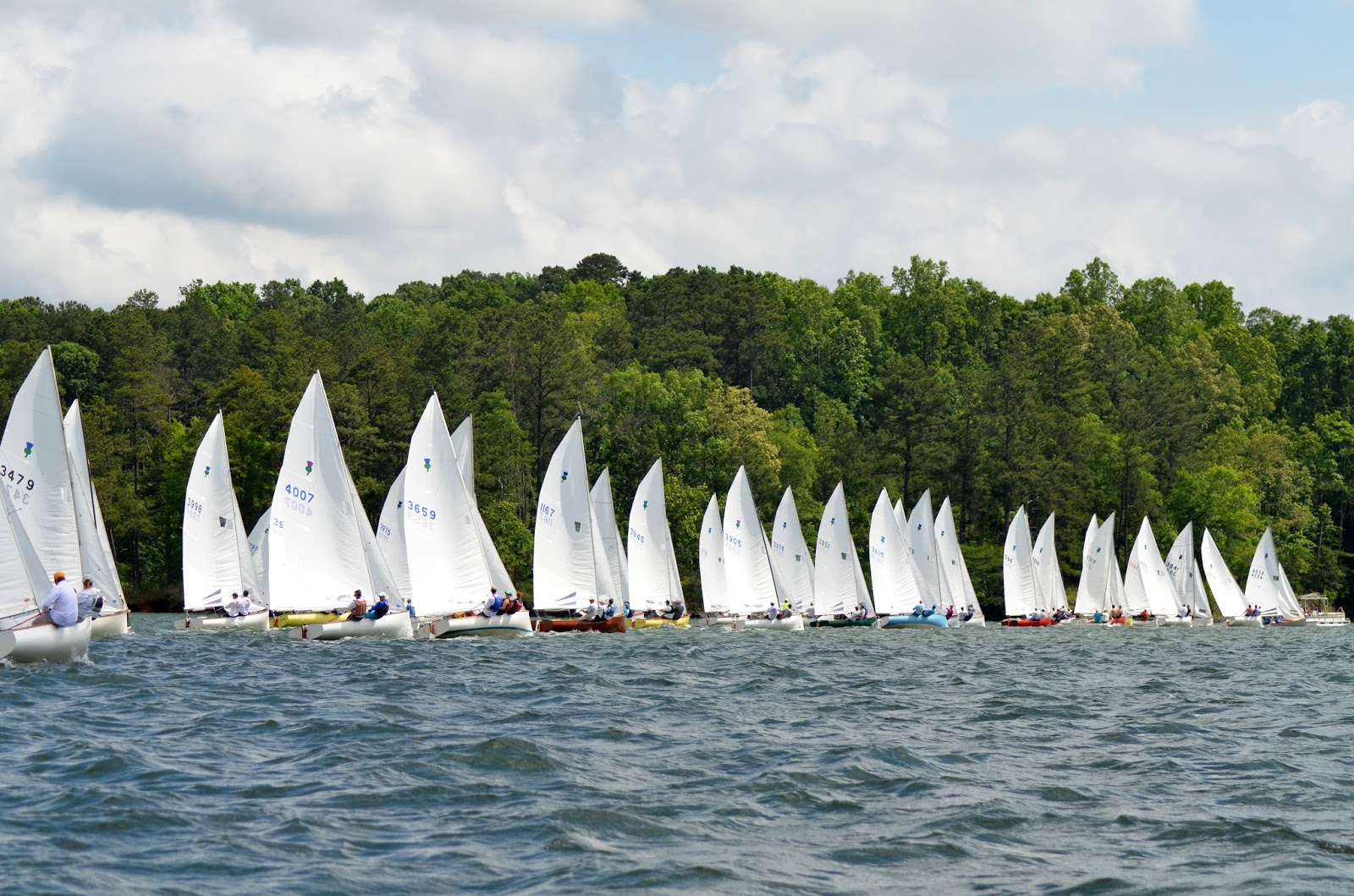
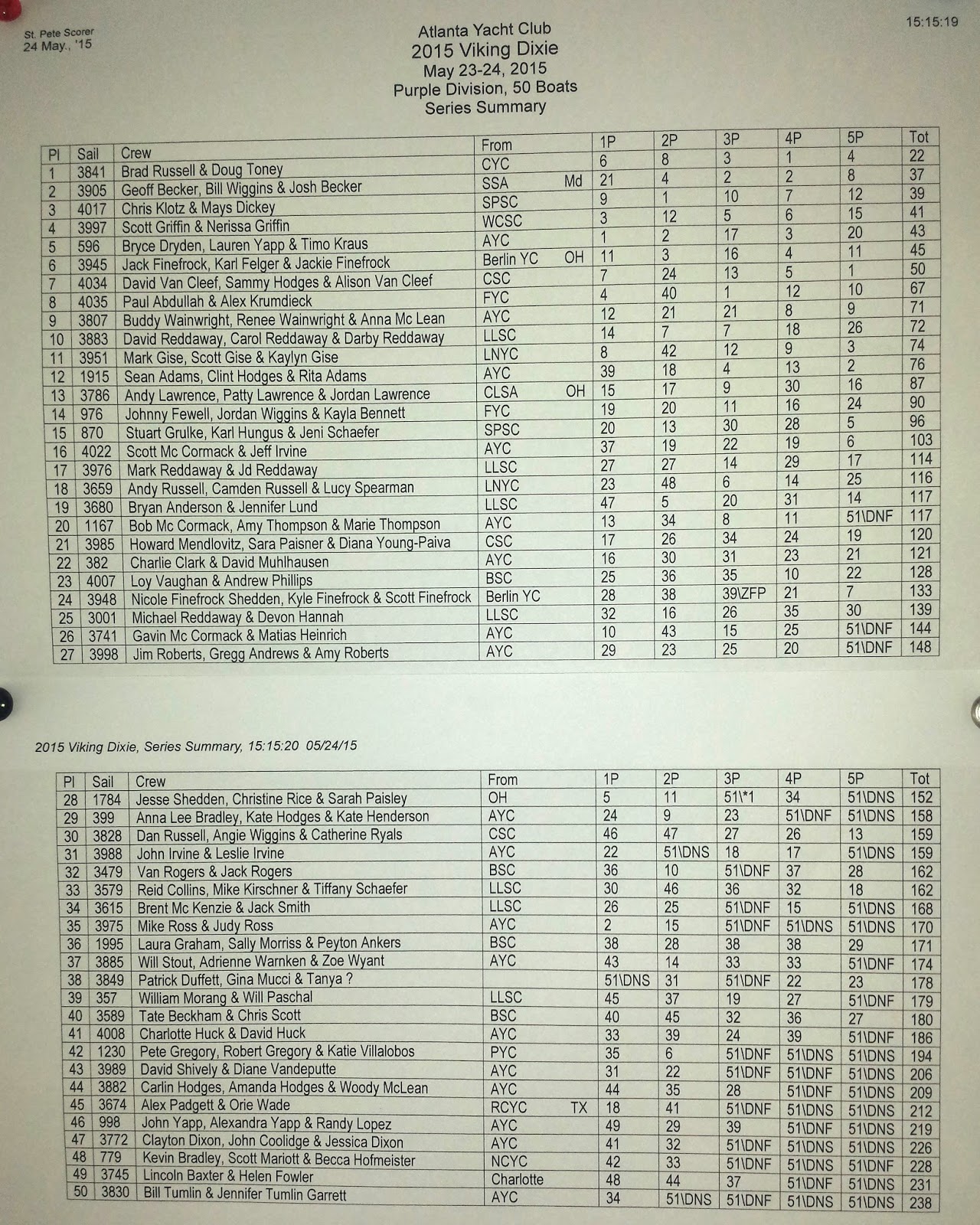
The 2015 Dixie Regatta in Acworth, GA had 66 Thistles over Memorial Day weekend for what turned out to be a great weekend of sailing on Lake Allatoona. 5 races for the Purple Fleet (50 boats) and Green Fleet (16 boats) were run in 5 to 15 knots through shifts of more than 50 degrees and a little bit of holiday weekend motorboat chop.


Two races Saturday saw little predictability and each leg favored one side strongly over the other, with the middle rarely working. Douglas Toney, my great friend and regular crew, sailed with me and did a fantastic job all weekend managing the course, the fleet, and me. We focused very hard on trying to stay consistent. Throughout the weekend we tried to make tough decisions, knowing we would throw away an opportunity to pass 2 or 3 boats to protect ourselves against a group of 10 or more. I believe that paid big dividends over the course of 5 races, as we were able to avoid the one or two bad races that almost everyone else experienced.


We didn’t always pick the correct side of the first beat and I didn’t always get the boat off the line in a great spot. But we were able to get clear air within a minute, go fast on our side of the course, and use any chance to consolidate our position and risk on the fleet. Our boat had great speed all weekend and even when we went the wrong way we were able to get to the top mark in the top ten each race. It was often hard to make the decision to tack back to the middle of the course without a shift and when you thought there was a puff and a header a little further out, but our plan was to keep risk as low as possible and it paid over the long haul.

Bryce Dryden led the regatta Saturday night after a 1, 2 day, followed by fellow past-national champion Chris Klotz and long time Thistler Jack Finefrock. We were happily in 4th with a 6, 8. The scores clearly indicated how easy it was for great sailors to put up a big number.


Sunday came with a bit more breeze and slightly less unpredictability (but still nowhere close to predictable). I was able to start the boat well and we were picking the correct end of the line, so we were in a good position early in all 3 races. The shakeups in scoring continued and we led the regatta after one race with a third and some bigger numbers by the boats around us.

We continued sailing for consistency and minimizing risk, but on the downwinds especially you had to go wherever you thought the next puff was coming from. Otherwise, it was easy to lose 15-20 boats on a leg. We got a bit fortunate downwind in the 4th race and took the lead and were able to hold it for the rest of the race while also keeping our risk very low.


Going into the last race, the regatta was still up for grabs between us, Bryce Dryden, Geoff Becker, and Scott Griffin. Lucky for us, we had a great start in the last race and all our competition found trouble early on the first beat. We were able to back off and play extra conservative for the remainder of that race to win the regatta.

By far, consistency was what won us the regatta. It was our ability to not put up a high score (our worst race was an 8th), and not an ability to win races, that won the event. The biggest key to being able to make those safe decisions was our boat speed.

Sailing 2-up, we were grossly overpowered for a lot of the weekend. To stay upright we had to aggressively depower the boat, often having maximum outhaul, cunningham, and vang. The difference I noticed in our boat and many others was how often and aggressively we played the mainsheet. I was easing the main as far and fast as it took to keep the boat standing upright and not heeling. My main was often out much further than I’m accustomed to seeing, but that’s what it took and gauging on nearby boats told us it was working.

With finishes of 6, 8, 3, 1, and 4 we were able to end the weekend at 22 points, ahead of first time Thistle skipper Geoff Becker with 37, Chris Klotz with 39, Scott Griffin with 41, and Bryce Dryden with 43. Larry Wagner won the Green Fleet, followed by Jack Mahaney and Len Wert. Thanks to my crew Doug and everyone at Fleet 48 for putting on a great event.

I use a Fisher main and a Proctor jib with the 0.5 oz Full Radial spinnaker. My diamonds are 4-9-4 on the black pro gauge. Rake is 27’ 0”, forestay is 24, and prebend is just over 1 inch. I use a shim under the front of my mast butt, as my mast is more bendy than most. The shim along with the lower forestay tension (normal is 26.5) is required to get my overbend wrinkles correct, which is halfway back the window in the main when full trimmed and not overpowered.

If you have any questions about tuning, trimming, or sailing your boat please email me at bradarussell@gmail.com or call me at 704-779-9377.

Purple Fleet Results


Green Fleet Results

Monday, April 27, 2015

Carolinas Districts Report 2015

We had 16 boats at our 2015 Thistle Carolina Districts Regatta April 24-25, 2015 near Raleigh, NC, our best turnout yet!


Saturday started off with some breeze and we got off one race with winds at around 5-8 knots but dropped for the second one to a light air race where finding the next puff was most important. Scott Griffin won the first race while Brad Russell tallied an OCS, followed by Mark Gise and John Norton.


Racing was particularly tricky Saturday due to the combination of light air and rain.  The tell tales were stuck and the shifts were large.  Often we had to hunt for the right angle to the breeze with a pure guess and go by feel when it was working or not.  It made steering well a crazy challenge.


The second race saw a massive split with a couple boats going hard left and the majority going hard right.  Left paid and the breeze died.  Brad Russell was followed by John Gilmour and Scott Griffin asthe lake went completely dead.


After day 1, top 5 were Scott Griffin, Mark Gise, John Norton, John Gilmour, and Sara Paisner.


Saturday night the social was held at Sara Paisner and Howard Mendlovitz's house with support from the entire local Thistle Fleet. From what was heard during the party, a fun time was had by all.


Sunday dawned breezy and some teams debated heading out due to the big breeze. Three races were sailed in great conditions. Breeze was 10-20 with big gusts and shifts.  As long as you stayed in phase with the shifts it became a boat speed day.  Everyone was way overpowered and it was technique that seemed to pay the biggest dividends.


With my dad, Andy Russell, crewing for me we focused on staying on the long tack to the mark, getting the next puff we could see and read, and working really hard on straight line speed.  We were fortunate to be very fast in those conditions and the feedback from Andy was that we were playing the mainsheet more often and more aggressively than the other boats around us.


When you’re that overpowered you don’t need any more drive forward, so you’re trying to keep the boat upright to minimize slipping to leeward. We were having to ease the mainsheet out several feet to keep the boat upright.  But we were also very quick to pull it back in as soon as the puff passed.  The technique requires near-constant trimming and easing, but it seems to pay.  


Brad and Andy Russell won all 3 races Sunday.  Racing was very tight and mixed after that with boats 2 through 8 on the day being very tightly bunched.  


After 3 more races top 5 finishers were
1. Scott and Nerissa Griffin and Harry Mendlovitz (age 8)
2.  Mark and Scott Gise
3. Brad and Andy Russell
4. Dan and Tom Russell
5. Sara Paisner, Meg Wannamaker, and Bobby Williams (High School Sailor)


We had lots of family boats and some youth sailors which was great for the fleet. The Carolina Districts is growing as more smart sailors realize just how incredible the Carolinas are!

A great weekend of sailing and camaraderie.


Race #1Race #2Race #3Race #4Race #5
PlaceSkipperSail #FinishFinishFinishFinishFinishTotal
1Scott Griffin39971352415
2Mark Gise39512423617
3Brad Russell3841OCS (17)111121
4Dan Russell382810538228
5Sara Paisner39855894329
6John Norton37253985530
7John Howell384941566839
9Scott Buehler3687131447745
8John Gilmour31411121211945
11Adam Coker39058121091150
10Lincoln Baxter37459613121050
12Steve Cardoze3739611710OCS (17)51
13Clayton Gray1492710DNC (17)DNC (17)DNC (17)68
14Kirk Kitchin3740141314141368
15John Pelosi3602127DNC (17)DNC (17)DNC (17)70
16David Morris153DNC (17)DNC (17)11131270